The hub for your medical watch

The regulatory news, the guidelines and the literature of your specialty,
in a single feed, readable in two minutes.

MedNews

MedNews on the phone, your specialty feed: regulation, guidelines and innovation
Hundreds of publications analysed every day, a handful kept for your specialty. The Official Journal, ANSM, HAS, learned societies and indexed literature. Sorted every day, checked by a collective of physicians, and every article links back to its source document.
Swipe
what interests you.

The feed is held in one hand, standing, between two patients. Each screen carries a single article: what it changes, its source, its date. You scroll until a title stops your thumb.

  • We go down from one article to the next. Nothing to open, nothing to close.
  • We stop when the title concerns you: the analysis, then the source document, are one tap away.
  • We keep what matters, you skip the rest. The next day's feed takes it into account.

The form is that of the apps you open without thinking. What passes through it comes from the Official Journal, HAS, ANSM and the indexed journals, and every screen names its source.

Your watch holds
en trois piles

And until now, you had to go and find them in three different places, with three rhythms and three vocabularies.

The first stack
Scientific articles

The trials and meta-analyses that move a decision. The ones you promise yourself you will read, and never do, because they arrive by the dozen and never sorted.

NEJM · The Lancet · JAMA · PubMed · learned societies
The second
The guidelines

What covers your practice if a complication occurs. Published as it comes by dozens of learned societies, with nobody telling you when it changes.

HAS · ESC · AHA · ACC · French and European learned societies
The third
Your regulatory obligations

Reimbursement, coding, marketing authorisation withdrawals, safety alerts. The news you always discover too late, and the only kind that is legally binding.

Journal officiel · ANSM · HAS · EMA · Assurance Maladie · Ordre
What sets us apart

The first medical watch hub.
Swipeable, every day, in two minutes.

No more chore of keeping up. French regulation, the guidelines and the literature of your specialty arrive sorted, in a single feed, and you stay informed without spending your evenings on it.
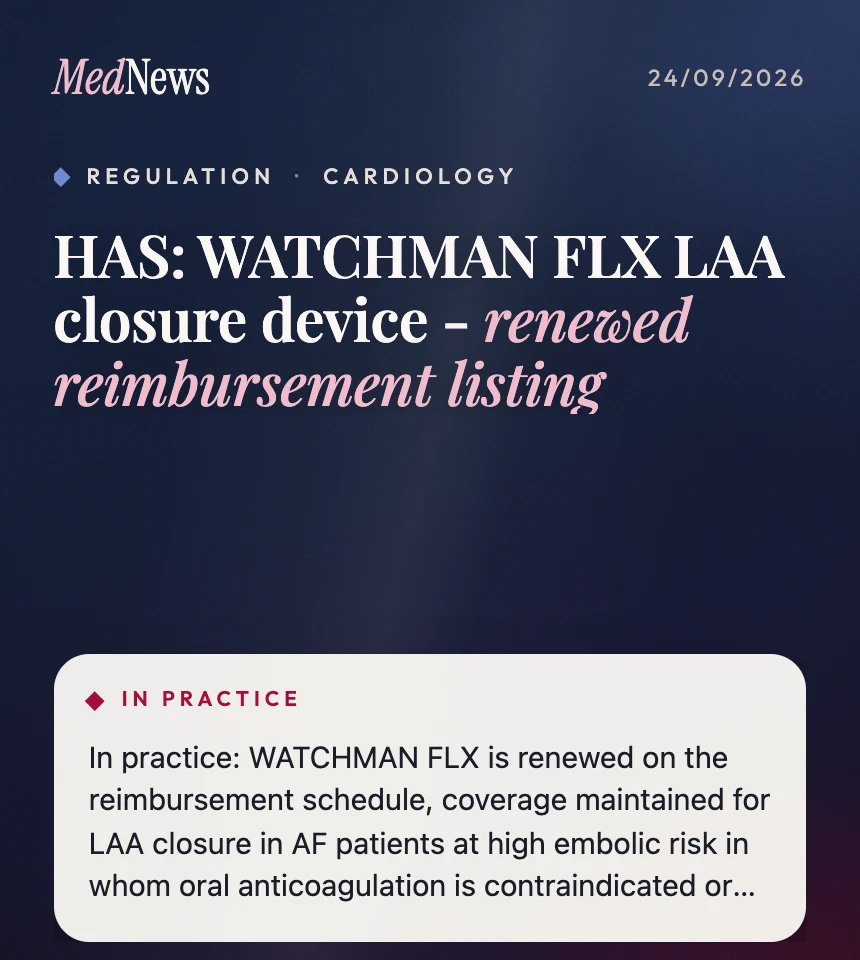
A card from the feed: a text from the French Official Journal on reimbursement, dated, with its regulatory watch label
French regulatory news

Official Journal, ANSM, HAS, reimbursement, fee agreements. Written in practical consequence, never as a press release.
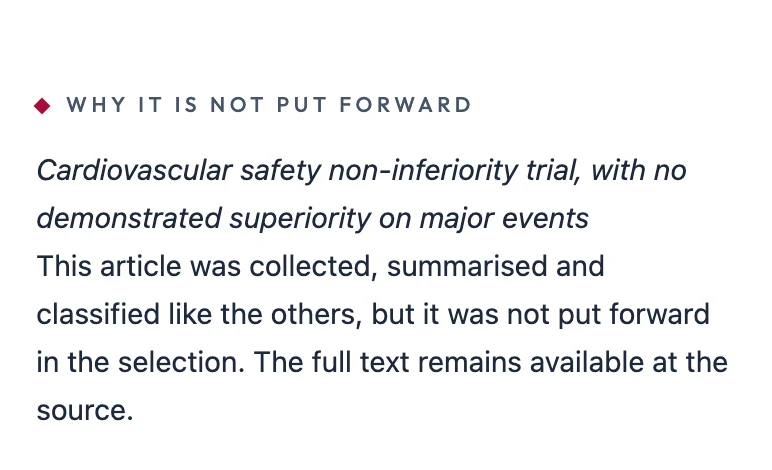
The « Why it is not put forward » block: the methodological reason shown under a corpus article
We set aside, and we say why

Nearly 500 publications a day, one or two selected for your specialty. The rest joins your corpus, with its reason.
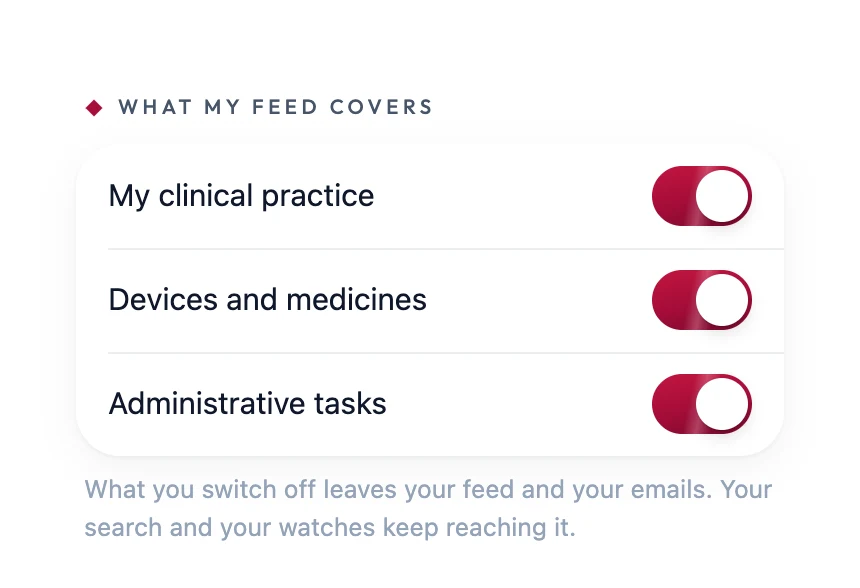
The « What my feed covers » setting: three switches, clinical practice, devices and medicines, administrative tasks
You stay in control

The feed learns from your gestures, and you switch off what does not concern you. Your search, however, keeps seeing everything.
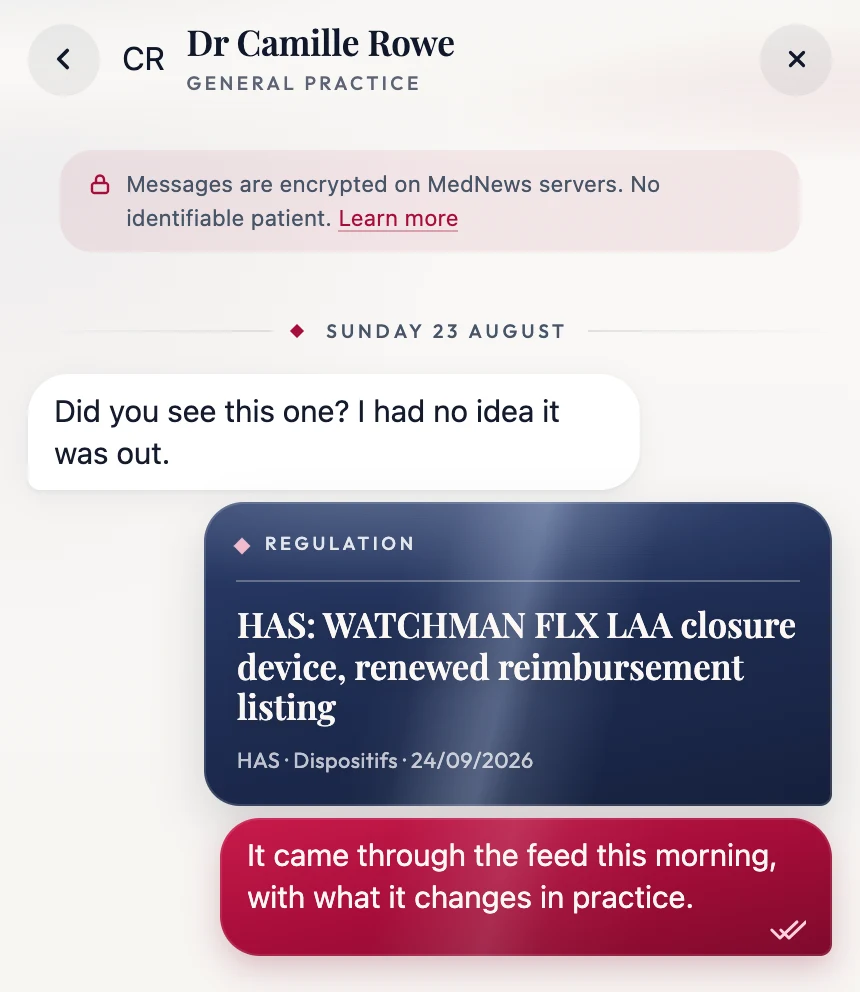
A MedNews message thread: a text from the French Official Journal shared with a connection, and two messages exchanged about it
Between practitioners

An article can be sent to a connection and is discussed by private message, without leaving the app.

Installer MedNews 37 specialties · no advertising · funded by subscription alone
What you open
every day
My specialty
Your month, in three stacks

The regulatory news, the guidelines and the literature of your specialty, counted and sorted. Nothing from the other specialties.

My specialty screen: regulation, guidelines and innovation counted for the month
The feed
Every article says what it changes

The title, the practical consequence, the source and its date. Enough to decide in three lines whether it concerns you.

The feed: every article with its section, its source and its date
The article
The analysis, then the document

A summary written for the practitioner, the key points, and the link to the source text. Never a claim without its source.

A MedNews article: analysis, key points and a link to the source document
My watches
Follow a topic that matters to you

A molecule, a device, a condition. MedNews scans every source, across all specialties, and understands meaning: follow « semaglutide », and you also receive what only writes « Ozempic ».

My watches: followed topics, associated terms, article counts and suggestions for the specialty
For you
A feed that sharpens with every gesture

One article per screen, scrolled with your thumb: the title, what it changes, the source. What you keep and what you skip set the next day's selection. This is a watch done standing up, between two patients, not a folder you open on a Sunday evening.

For you: one article per screen, with its practical consequence, its source and its date
Personalisation
And you stay in control

The feed learns on its own, but you can set it yourself: untick the sub-categories and areas of your specialty you do not practise. Nothing is lost for all that, your search and your watches keep reaching them.

Personalisation: the sub-categories and areas of the specialty, to tick or untick
Explore
And everything else, when you look for it

The other specialties, the archives and the search, which understands synonyms: look for MI, find myocardial infarction.

Explore: the list of followed sources, how many publications each has, and when it last appeared
How it works
From the source
to your portal

From the French Official Journal to indexed publications, every document is collected, qualified by specialty and made readable in three steps.

01
Collecte

Official texts, guidelines and more than six hundred indexed journals, aggregated continuously.

02
AI triage, medical oversight

An AI sorts by section and by specialty. A collective of physicians is responsible for checking the quality.

03
Delivery

The portal is updated every day. The newsletter arrives at the rhythm you set, from daily to monthly.

The information that comes to you
Between two consultations.
At the end of a shift. On a Sunday evening.

MedNews is read wherever you have 5 minutes. By email or on your phone.

newsletter@mednews.fr
Newsletter MedNews
The newsletter · read in 5 minutes
Your review,
in your inbox

An email written for your specialty, at the rhythm you choose: every day, every two days, every week or every month. Each article fits in three lines, with the concrete impact on your practice and the link to the primary source.

3 rubriques Ranked by clinical priority Frequency of your choice Source verifiable in one click
Get the next one →
37 medical specialties
and allied health

From anaesthesiology to urology, every discipline receives an analysis calibrated on its own standards, its sources and its learned societies.

Anaesthesiology
Laboratory medicine
Cardiology
Cardiac surgery
Dental surgery
Orthopaedic surg.
Paediatric surg.
Plastic surgery
Thoracic surgery
Vascular surgery
Dermatology
Endocrinology
Gastroenterology
Geriatrics
Gynaecology
Haematology
Infectious diseases
Nurses
Physiotherapy
Emergency medicine
General practice
Internal medicine
MPR
Nephrology
Neurosurgery
Neurology
Oncology
Ophthalmology
ENT
Paediatrics
Pharmacists
Respiratory medicine
Psychiatry
Radiology
Rheumatology
Midwives
Urology
Pricing
Practitioner or student

Free for students. First month free at sign-up for practitioners. Cancel at any time.

Gratuit
Student
0
/ on proof of enrolment
Portail complet · 3 rubriques
Newsletter by specialty, at the frequency you choose
Full archives since launch
Urgent alerts by email
Bookmarks and advanced search
Specialty focus, zero noise
Sign up free
MedNews is built by
practitioners, for practitioners.
Maxence Albertin · Fondateur MedNews
Maxence Albertin
Co-fondateur & CEO

A physician has no time to read. They need someone to read for them, and to pass on only what changes their practice.

Arthur and Maxence watched rigorous practitioners miss critical ANSM alerts, purely for lack of time. They founded MedNews so that it would stop happening: everything is read, every day, and only what matters reaches you. 5 minutes a week instead of 7 hours.

LinkedIn
Arthur Aupaix · Co-fondateur & Responsable commercial MedNews
Arthur Aupaix
Co-fondateur & Responsable commercial

Our job is to make medical watch obvious: a tool a practitioner adopts in five minutes and never lets go of.

Arthur leads the relationship with practitioners and healthcare organisations. His role: to turn what the field needs into a product that fits into daily practice, and to make MedNews known to those who need it most.

LinkedIn
Questions
frequent

Everything you need to know before signing up.

Sign up
37 medical and surgical specialties, from general practice to vascular surgery by way of oncology, neurology and paediatrics. Each discipline has dedicated PubMed sources and a personalised portal.
The portal is fed every day: ANSM alerts, new articles, texts from the Official Journal. The summary newsletter for your specialty follows the rhythm you choose in your settings: daily, every two days, every four days, weekly, fortnightly or monthly. It goes out every two days until you change it, and the setting can be changed at any time.
On three counts. First the scope: MedNews brings into a single feed what you used to look for in three places, including French regulation (the Official Journal, ANSM, HAS, reimbursement, fee agreements) that scientific watch tools do not cover. Then the triage: close to 500 publications are analysed every day, one or two are kept for your specialty, and every article is rewritten as a practical consequence rather than as an abstract summary. Finally the use: one article per screen, scrolled standing up between two patients, instead of a list of references to open on a Sunday evening.
They stay in your corpus. An article that is valid but not selected is still analysed, classified in your specialty and searchable at any time, with the reason it was not put forward (limited numbers, intermediate endpoint, confirmatory result…). The topics you follow keep reaching them, including on a highly specialised question: sorting what goes to the front never amounts to deleting the rest.
Two minutes a day on your phone is enough to see what changes for you go past. If you prefer email, your specialty newsletter reads in five minutes, at the rhythm you set, from daily to monthly. Both serve the same feed: there is nothing to catch up on from one channel to the other.
Yes. The triage and the formatting are produced by AI, and a collective of physicians is responsible for checking the quality. The primary sources are always one click away.
€9.99/month, cancel at any time. The first month is free when you create your account, with no immediate charge.
Yes. MedNews is entirely free for students, on presentation of proof of enrolment at sign-up. You get exactly the same full access as practitioners: portal, specialty newsletter, archives and alerts.
Completely. MedNews is funded by subscription alone. No advertising, no partnership with pharmaceutical companies, no sponsored content.
Yes. You can select several specialties in your profile and receive a portal and a newsletter for each of them.
786 active sources to date, including around twenty journals dedicated to each specialty, from thirteen to more than forty depending on the discipline. To these are added the sources common to all practitioners: the Official Journal, ANSM, HAS, EMA, FDA, learned societies, and the major general journals.
As a rule, yes. Your portal and your newsletter are filtered for your specialty. Some cross-cutting information, a new regulatory text, a pharmacovigilance alert or a guideline touching several disciplines at once, may appear in your feed when it concerns you directly.
You cannot read everything.
We do.

Two minutes a day so you miss nothing in your specialty. The rest, we read for you.

Access MedNews for free
First month free · Cancel any time